Optical grade quartz wafers are essential materials in advanced photonics, semiconductor processing, precision optics, and high-frequency electronics. Known for their exceptional optical clarity, thermal stability, and chemical resistance, these wafers are widely used in applications where performance and reliability are critical.
As industries such as semiconductors, laser technology, optical communication, and aerospace continue to grow, the demand for high-quality quartz substrates is increasing rapidly. This guide explains what optical grade quartz wafers are, their key advantages, typical specifications, and how to select the right wafer for your application.
Optical grade quartz wafers are high-purity substrates made from fused quartz or crystalline quartz that are processed to meet strict optical and surface quality standards. These wafers provide extremely low impurity levels, excellent light transmission, and stable mechanical properties.
Unlike standard industrial quartz, optical grade quartz wafers undergo advanced manufacturing processes including:
Precision crystal growth
High-purity material selection
Double-side polishing
Surface defect control
Strict optical inspection
These processes ensure the wafers meet the requirements for optical systems and high-precision devices.
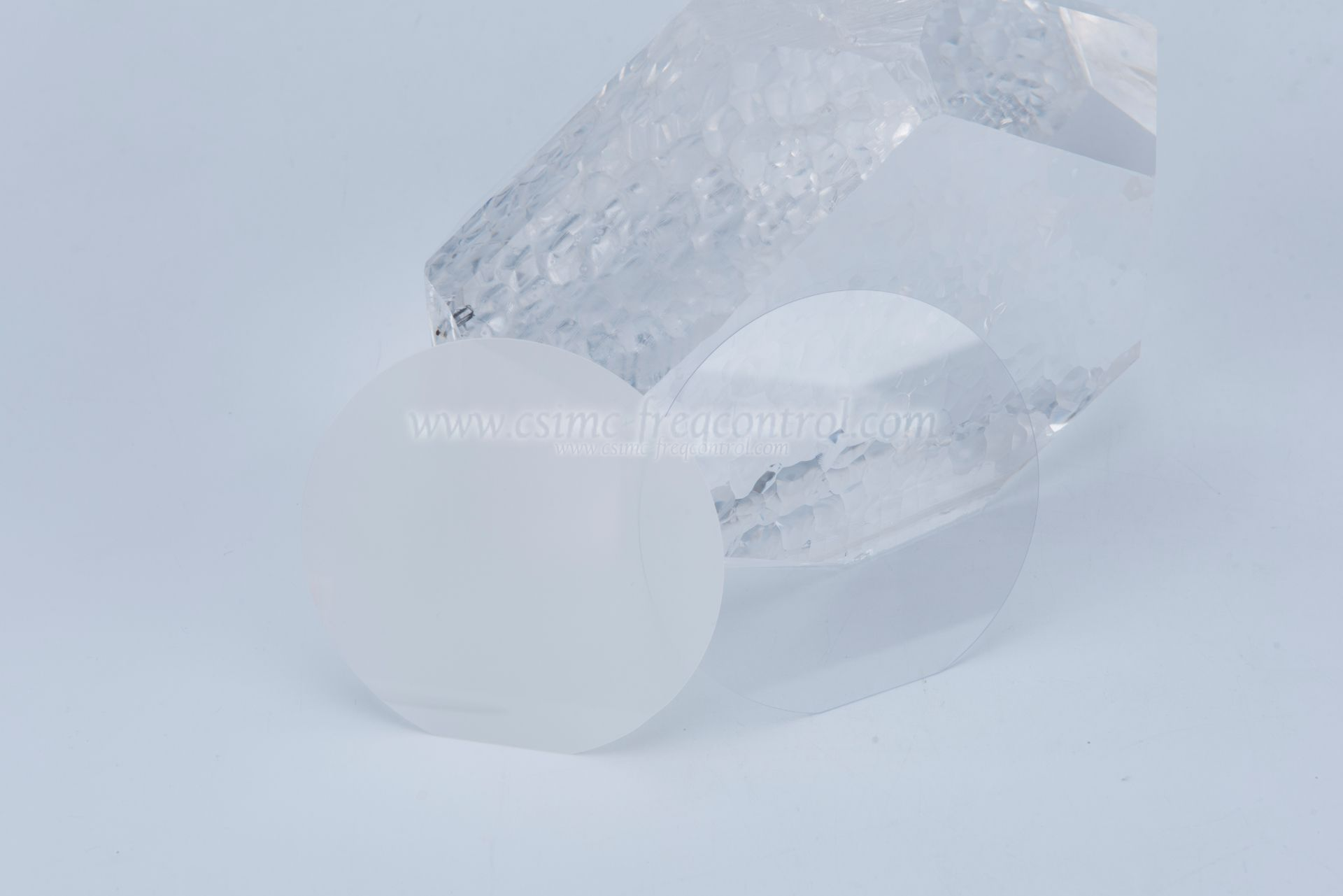
Optical grade quartz substrates offer a unique combination of optical and physical characteristics that make them suitable for demanding applications.
High Optical Transmission
Quartz wafers exhibit excellent transmission across a wide wavelength range, including:
Ultraviolet (UV)
Visible spectrum
Infrared (IR)
This makes them ideal for optical instruments, laser components, and photonics devices.
Ultra-Low Thermal Expansion
Quartz materials have extremely low thermal expansion coefficients, allowing devices to maintain dimensional stability even under temperature fluctuations.
Exceptional Thermal Resistance
Quartz wafers can withstand high temperatures without deformation, which is critical in semiconductor and vacuum processing environments.
Excellent Chemical Stability
Optical grade quartz is highly resistant to:
Acids
Alkalis
Plasma environments
Corrosive chemicals
This property makes it suitable for harsh manufacturing processes.
High Surface Quality
Double-side polished quartz wafers provide:
Low surface roughness
Minimal subsurface damage
High optical uniformity
These characteristics are essential for photonics and microfabrication.
Different types of quartz wafers are designed to meet specific technical requirements.
Fused Quartz Wafers
Fused quartz wafers are produced by melting high-purity silica and cooling it into an amorphous structure.
Key advantages:
High purity
Excellent UV transmission
Uniform optical properties
Low birefringence
These wafers are widely used in photolithography and laser optics.
Crystalline Quartz Wafers
Crystalline quartz wafers are grown using controlled crystal growth processes and exhibit anisotropic properties.
Typical applications include:
Frequency control devices
Resonators
Optical sensors
Piezoelectric components
Synthetic Quartz Wafers
Synthetic quartz provides extremely low defect density and high performance for demanding optical applications such as:
Advanced semiconductor lithography
Precision optical instruments
Aerospace optics
Manufacturers can supply optical grade quartz wafers with a variety of customizable specifications to meet different device requirements.
Common specifications include:
Wafer Diameter
2 inch
3 inch
4 inch
6 inch
8 inch
Thickness Range
100 µm to several millimeters
Surface Finish
Single-side polished (SSP)
Double-side polished (DSP)
Optical grade polishing
Surface Roughness
Typically < 1 nm Ra for high-end optical applications
Flatness and Parallelism
Controlled for high-precision optical alignment
Custom orientations and wafer shapes are also available for specialized devices.
Optical quartz wafers are widely used across multiple high-technology industries.
Semiconductor Manufacturing
Quartz wafers play a key role in semiconductor fabrication processes such as:
Photolithography systems
Wafer processing equipment
Plasma etching systems
Mask substrates
Their stability and purity make them reliable for precision manufacturing.
Optical Communication Systems
Quartz wafers are widely used in fiber optic and photonic components including:
Optical modulators
Waveguides
Optical filters
Integrated photonic circuits
Laser Technology
Due to their excellent optical transmission and thermal stability, quartz wafers are used in:
Laser cavities
Optical windows
Beam shaping components
High-power laser systems
MEMS and Sensors
Quartz substrates are ideal for microfabrication and sensing devices such as:
MEMS sensors
Pressure sensors
Resonators
Microfluidic devices
Aerospace and Scientific Instruments
Optical grade quartz is commonly used in:
Space optics
Precision measurement systems
Spectroscopy equipment
Scientific research instruments
Optical grade quartz wafers are a critical material platform for photonics, semiconductor processing, and precision optical systems. Their exceptional optical transparency, chemical resistance, and thermal stability make them an ideal choice for high-performance applications.
With flexible specifications, advanced manufacturing processes, and broad industry applications, quartz wafers continue to play an important role in modern technology development.



Copyright © Hangzhou Freqcontrol
Electronic Technology Ltd.
All Rights Reserved | Sitemap |
Powered by 







 中文
中文


