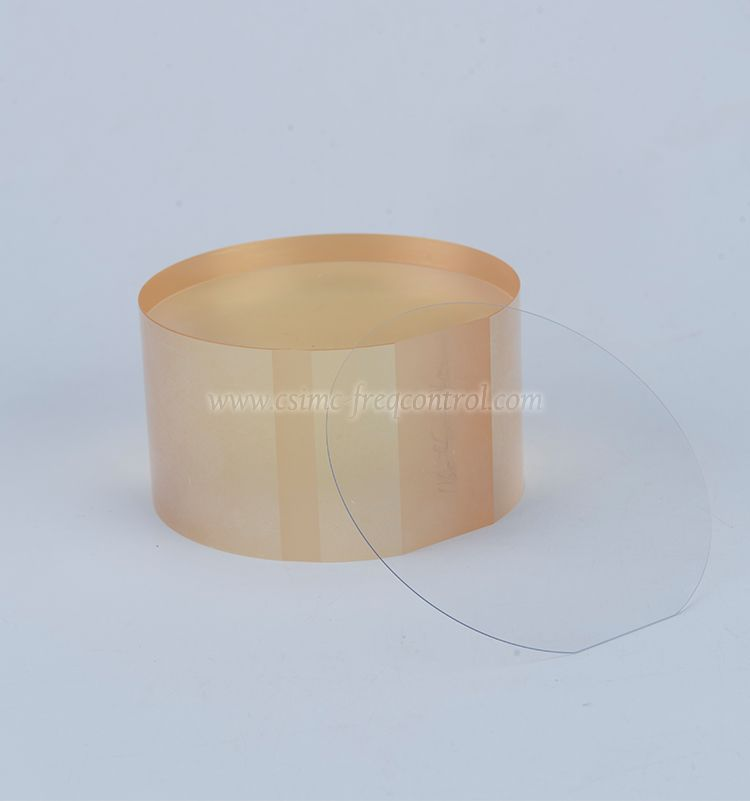
Lithium tantalate (LiTaO₃) wafers are high-performance single-crystal substrates widely used in electronics, photonics, and piezoelectric devices. Known for their excellent electro-optic, piezoelectric, and pyroelectric properties, lithium tantalate wafers are critical components in advanced communication systems, sensors, and laser technologies.
These wafers are precision-cut slices of single crystals and polished to high optical quality, providing stability, reliability, and superior performance across demanding applications.
Strong Piezoelectric Response
Lithium tantalate exhibits a strong piezoelectric effect, converting mechanical stress into electrical signals and vice versa. This makes it ideal for surface acoustic wave (SAW) devices, actuators, and precision sensors.
Electro-Optic Capabilities
LiTaO₃ has a high electro-optic coefficient, enabling modulation of light in response to electric fields, which is crucial for optical modulators and advanced photonic devices.
Pyroelectric and Ferroelectric Properties
Lithium tantalate is pyroelectric, generating a voltage when exposed to temperature changes. This property is utilized in infrared detectors and thermal sensors. Its ferroelectric nature allows polarization switching, important for nonlinear optics and memory devices.
Optical Transparency and Thermal Stability
LiTaO₃ is transparent across a wide spectrum (350–5000 nm) and maintains performance across varying temperatures, making it suitable for high-power lasers, infrared applications, and harsh industrial environments.
Crystal Growth
Lithium tantalate single crystals are grown using the Czochralski method, with precise control over stoichiometry and temperature to minimize defects and achieve uniformity.
Orientation and Cutting
Crystals are oriented along specific axes (X, Y, Z, or rotated cuts) depending on their intended application. Precision diamond saws slice the crystals into wafers with strict thickness tolerances.
Polishing and Surface Treatment
Multi-step polishing ensures ultra-smooth surfaces and minimal scattering. Optical-grade wafers may undergo chemical-mechanical polishing (CMP) to meet high-precision photonics standards.
Doping and Coating
Certain wafers are doped with elements like magnesium or zinc to enhance photorefractive resistance and high-power laser compatibility. Anti-reflective coatings improve optical throughput for laser and photonic applications.
Telecommunications
LiTaO₃ wafers are used in optical modulators, frequency shifters, and SAW devices, enabling high-speed data transfer and signal processing in fiber-optic communication networks.
Consumer Electronics
They are used in infrared sensors, accelerometers, and precision actuators for smartphones, cameras, and wearable devices.
Medical Devices
Lithium tantalate wafers power laser surgery systems, ultrasound transducers, and infrared imaging devices, providing high precision and reliability.
Defense and Aerospace
Their stability under extreme conditions makes LiTaO₃ wafers suitable for navigation sensors, satellite communication devices, and high-performance acoustic sensors.
Application Requirements: Determine the necessary orientation, thickness, and doping based on device function.
Surface Quality: Optically polished surfaces minimize scattering and maximize signal fidelity.
Temperature and Power Handling: Choose wafers suitable for high-power laser or high-temperature environments.
Cost vs. Performance: Balance wafer quality with project budget, especially for mass production applications.
Thin-Film Lithium Tantalate on Insulator (LTOI): A growing technology for miniaturized photonic circuits.
5G and Next-Gen Telecom: High-speed modulators using LiTaO₃ wafers are driving demand.
Quantum and Nonlinear Optics: LiTaO₃ wafers are critical for frequency conversion and quantum photonic applications.
Sustainable Manufacturing: New crystal growth and polishing methods reduce production costs and material waste.
Lithium tantalate wafers are essential for modern photonics, electronics, and sensing technologies. Their piezoelectric, electro-optic, and pyroelectric properties, combined with optical transparency and thermal stability, make them versatile and reliable.
By understanding wafer types, material properties, and application requirements, engineers and buyers can choose optimal solutions for high-performance devices. With innovations like LTOI and next-generation modulators, lithium tantalate technology continues to drive advancements in telecommunications, medical equipment, consumer electronics, and aerospace industries.



Copyright © Hangzhou Freqcontrol
Electronic Technology Ltd.
All Rights Reserved | Sitemap |
Powered by 







 中文
中文


