As wireless communication technologies continue to evolve, RF (radio frequency) modules are required to deliver higher performance, lower power consumption, and greater signal integrity. From 5G smartphones and IoT devices to automotive communication systems and satellite applications, RF front-end components play a crucial role in ensuring reliable signal transmission.
Among the advanced piezoelectric materials used in RF devices, Lithium Tantalate (LiTaO₃) wafers have become a preferred substrate for manufacturing high-performance Surface Acoustic Wave (SAW) filters, resonators, and other RF components.
Their excellent electromechanical properties, stable temperature behavior, and superior acoustic performance make Lithium Tantalate an ideal material for modern RF module design.
This article explores the critical design considerations engineers and buyers should evaluate when using Lithium Tantalate wafers in RF modules.
Lithium Tantalate (LiTaO₃) is a synthetic piezoelectric crystal widely used in RF, optoelectronic, and sensing applications.
The material exhibits excellent electro-acoustic conversion efficiency, making it highly suitable for devices that convert electrical signals into acoustic waves and vice versa.
Lithium Tantalate wafers are commonly used in:
SAW filters
SAW resonators
Duplexers
RF front-end modules
Wireless communication devices
Sensor systems
As communication standards evolve toward higher frequencies and broader bandwidths, Lithium Tantalate remains one of the most important substrate materials in RF device manufacturing.
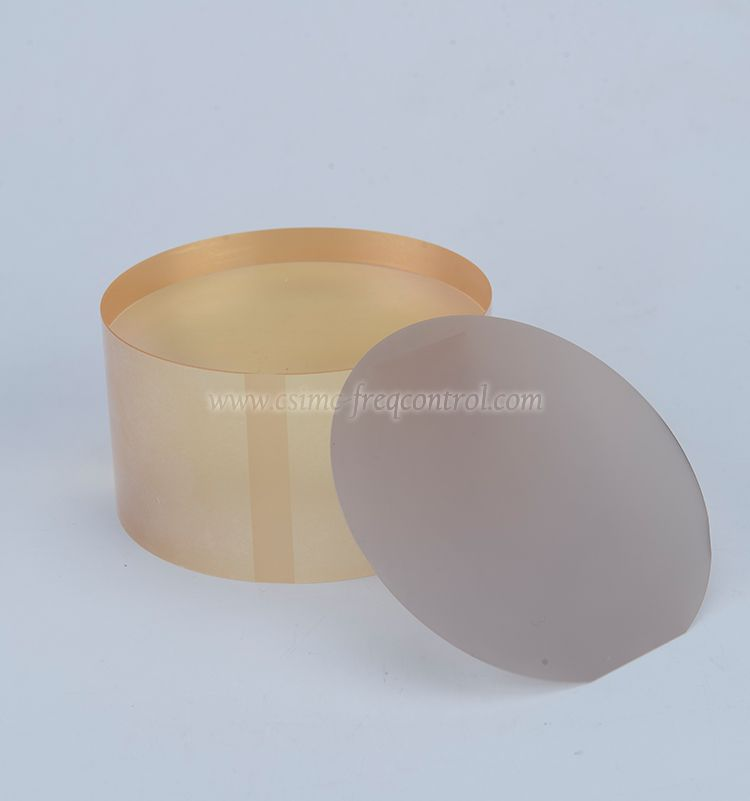
Lithium Tantalate offers several advantages over conventional piezoelectric materials.
Key benefits include:
High electromechanical coupling coefficient
Excellent frequency stability
Good temperature performance
Low insertion loss
High-quality factor (Q value)
Strong acoustic wave propagation characteristics
Mature manufacturing technology
These characteristics directly contribute to improved RF system performance.
1. Crystal Orientation Selection
Crystal orientation significantly influences RF device performance.
Different cuts affect:
Acoustic wave velocity
Electromechanical coupling
Temperature coefficient
Frequency response
Power handling capability
Common orientations include:
36° YX Lithium Tantalate
Suitable for:
High-performance SAW filters
Wide bandwidth applications
5G communication devices
42° YX Lithium Tantalate
Suitable for:
Lower insertion loss applications
Improved temperature stability
Selecting the appropriate crystal orientation is one of the most important decisions during RF module development.
2. Frequency Requirements
Modern RF modules operate across multiple frequency bands.
Lithium Tantalate supports applications ranging from hundreds of MHz to several GHz.
Designers must optimize:
Resonance frequency
Bandwidth
Harmonic suppression
Signal selectivity
Applications include:
Cellular networks
Wi-Fi
Bluetooth
GPS
IoT communication
Satellite communication
As frequencies increase, precision becomes increasingly important.
3. Wafer Thickness Selection
Wafer thickness directly impacts manufacturing processes and device reliability.
Factors influencing thickness selection:
Mechanical strength
Device miniaturization
Processing compatibility
Yield optimization
Ultra-thin wafers may improve packaging efficiency but require careful handling.
4. Surface Quality Requirements
Surface quality directly affects device performance.
Critical parameters include:
Surface Roughness
Lower roughness improves:
Acoustic wave propagation
Electrode adhesion
Device consistency
5. Thermal Stability Considerations
RF modules often operate under varying temperatures.
Thermal stability affects:
Frequency drift
Signal accuracy
Long-term reliability
Engineers should evaluate:
Temperature coefficient of frequency (TCF)
Operating temperature range
Thermal cycling performance
Compensation strategies may include:
Material combinations
Circuit optimization
Temperature compensation algorithms
6. Electrode Design Compatibility
Electrode materials must work effectively with Lithium Tantalate substrates.
Common electrode materials include:
Aluminum (Al)
Gold (Au)
Copper (Cu)
Aluminum-Copper alloys
Design considerations:
Adhesion strength
Conductivity
Thermal expansion matching
Corrosion resistance
Poor electrode compatibility can degrade RF performance over time.
7. Packaging Design Requirements
Advanced RF modules demand compact packaging solutions.
Packaging influences:
Signal integrity
Thermal management
Electromagnetic interference (EMI)
Mechanical reliability
Common packaging technologies include:
System-in-Package (SiP)
Advantages:
Smaller footprint
Better integration
Flip-Chip Packaging
Advantages:
Lower signal loss
Higher frequency performance
Multi-Chip Modules (MCM)
Advantages:
Enhanced functionality
Improved performance density
5G Smartphones
Applications include:
SAW filters
Duplexers
RF front-end modules
Benefits:
Higher bandwidth
Better signal quality
Lower power consumption
IoT Devices
Applications:
Wireless sensors
Smart home devices
Wearables
Benefits:
Miniaturization
Energy efficiency
Automotive Electronics
Applications:
Vehicle communication systems
V2X communication
ADAS systems
Benefits:
Reliability
Temperature stability
Wi-Fi and Bluetooth Devices
Applications:
Routers
Wireless peripherals
Consumer electronics
Benefits:
Signal filtering
Reduced interference
Satellite Communication
Applications:
High-frequency communication systems
Signal processing modules
Benefits:
Stable performance
Excellent frequency accuracy
Despite its advantages, Lithium Tantalate presents several manufacturing challenges.
Fragility
As a brittle crystal material, it requires careful handling.
Solutions:
Automated handling systems
Protective carriers
Precision Processing Requirements
Advanced RF devices demand extremely tight tolerances.
Manufacturing processes include:
Precision slicing
Double-side polishing
Chemical mechanical polishing (CMP)
Cost Considerations
High-quality Lithium Tantalate wafers require sophisticated manufacturing equipment and stringent quality control procedures.
Buyers should balance:
Performance requirements
Production volume
Budget constraints
When selecting a supplier, consider the following factors:
Manufacturing Capability
Look for suppliers that offer:
Crystal growth expertise
Precision wafer processing
Advanced polishing technology
Quality Control
Verify:
Surface roughness
TTV specifications
Crystal orientation accuracy
Defect inspection
Customization Support
Choose suppliers that can provide:
Custom diameters
Custom thicknesses
Specific crystal cuts
Specialized surface finishes
Technical Support
Strong engineering support helps accelerate product development and reduce production risks.
The growing adoption of advanced communication technologies will continue to drive demand.
Emerging trends include:
5G Advanced and 6G Networks
Higher frequencies require superior acoustic materials.
AI-Enabled Wireless Devices
More intelligent devices demand better RF filtering solutions.
Ultra-Compact Electronics
Miniaturization increases the need for high-performance substrates.
Autonomous Vehicles
Reliable wireless communication becomes increasingly important.
Lithium Tantalate will remain a critical material supporting future wireless innovations.
Lithium Tantalate wafers are essential materials for modern RF modules due to their excellent piezoelectric properties, high electromechanical coupling, and stable frequency performance.
Successful RF module design requires careful consideration of crystal orientation, wafer thickness, surface quality, thermal stability, electrode compatibility, and packaging requirements.
By selecting the right Lithium Tantalate wafer specifications and partnering with experienced suppliers, manufacturers can develop high-performance RF components that meet the demands of 5G, IoT, automotive, and next-generation communication systems.



Copyright © Hangzhou Freqcontrol
Electronic Technology Ltd.
All Rights Reserved | Sitemap |
Powered by 







 中文
中文


