Lithium Tantalate Wafers are single-crystal piezoelectric substrates used to convert electrical signals into surface acoustic waves (SAWs). In high-temperature SAW devices, they support filters, resonators, sensors, and frequency-control components that must operate reliably under heat, vibration, and electrical stress. For manufacturers, the value is practical: a properly specified lithium tantalate substrate can improve electromechanical coupling, device sensitivity, production consistency, and long-term signal stability. This is why Why Lithium Tantalate Wafers Remain Important in High-Temperature SAW Devices is an important engineering question for RF, wireless, aerospace, industrial sensing, and automotive applications.
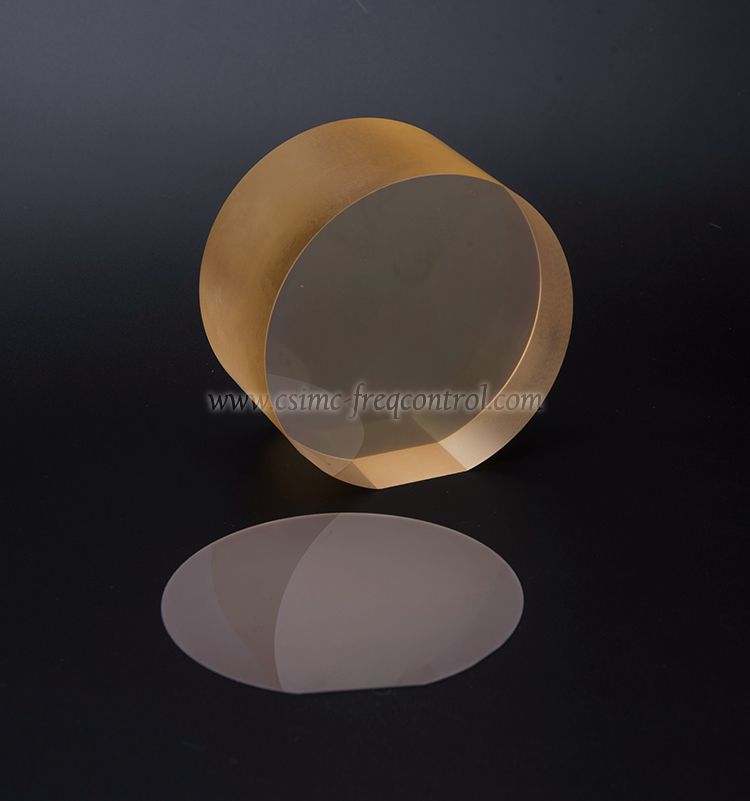
Lithium tantalate, commonly written as LiTaO3, is a ferroelectric crystal with strong piezoelectric properties. A wafer is a thin, polished section of this crystal, normally supplied with a defined crystal orientation, diameter, thickness, surface finish, and electrode-ready surface.
When an alternating electrical field is applied to a patterned electrode, the wafer generates a mechanical wave along its surface. This is the operating principle behind a SAW filter or resonator. The selected cut and propagation direction influence:
For buyers, the wafer is not simply a piece of crystal. It is a functional RF material whose crystallographic orientation and surface quality directly affect final device yield.
The answer begins with the balance between piezoelectric efficiency and thermal performance. Lithium tantalate offers strong electromechanical coupling, allowing compact interdigital transducers (IDTs) to excite useful acoustic energy. This is valuable when a device must maintain sensitivity without becoming unnecessarily large.
LiTaO3 provides a high piezoelectric response compared with many non-piezoelectric substrates. In SAW architecture, this can support efficient electrical-to-acoustic conversion and help engineers design narrowband filters, resonators, delay lines, and passive wireless sensors.
This characteristic is particularly useful in:
Lithium tantalate has a Curie temperature of approximately 605°C, although the maximum operating temperature of a finished SAW device is normally much lower. The Curie temperature should not be confused with a guaranteed device-use temperature. Packaging, metallization, bonding, electrode diffusion, thermal cycling, and TCF requirements often determine the real limit.
Even with this limitation, lithium tantalate remains attractive because it provides a useful thermal margin for applications exposed to engine compartments, industrial furnaces, downhole environments, and other elevated-temperature conditions.
SAW performance depends heavily on the wafer cut. Common orientations such as rotated Y-cut or specific Y-X propagation configurations are selected to balance coupling, TCF, and spurious response. A small orientation error can shift the resonant frequency or change the mode structure.
For this reason, a qualified supplier such as CQT should provide clear information about:
Piezoelectric materials became central to frequency control during the development of radio communication, sonar, and precision timing systems. Quartz was widely adopted because of its frequency stability, while ferroelectric crystals such as lithium niobate and lithium tantalate offered stronger coupling for compact acoustic devices.
As wireless communications expanded, SAW filters became essential in mobile phones, radio modules, and telemetry systems. At the same time, industrial and aerospace engineers began using SAW devices as passive sensors. These sensors can operate without a local battery because an external RF signal supplies energy and receives the reflected response.
High-temperature applications introduced additional challenges. Conventional semiconductor electronics may require cooling or protective enclosures, but a passive SAW sensor can be positioned close to the heat source. Lithium tantalate wafers therefore gained continuing importance in applications where compact size, wireless interrogation, and elevated-temperature operation are required together.
For an OEM, the most important issue is not only whether lithium tantalate works in principle. The real question is whether the wafer can be supplied with repeatable specifications that support mass production. CQT can be evaluated as a material and frequency-control partner by reviewing its crystal data, wafer tolerances, inspection process, and technical response capability.
SAW sensors based on lithium tantalate can be used for temperature, pressure, torque, and strain monitoring where wiring is difficult or exposed to heat. Wireless interrogation reduces the need for fragile electrical connections near rotating or high-temperature components.
Manufacturing equipment, chemical processing systems, and high-temperature chambers require sensors that remain stable during thermal cycling. A properly designed LiTaO3 SAW device can provide a frequency-coded response that is easier to transmit and process than a low-level analog signal.
In RF systems, the substrate influences filter bandwidth, insertion loss, power handling, and temperature drift. Lithium tantalate is suitable when strong coupling and compact electrode structures are more important than achieving the lowest possible TCF with an uncompensated substrate.
| Parameter | Why It Matters | What Buyers Should Confirm |
|---|---|---|
| Crystal cut | Controls coupling, TCF, and acoustic mode behavior | Exact cut, propagation direction, and tolerance |
| Wafer thickness | Affects handling, acoustic structure, and device integration | Nominal value and thickness tolerance |
| Surface roughness | Influences electrode adhesion, scattering, and yield | Ra/RMS value and measurement method |
| Flatness and TTV | Support lithography and uniform electrode fabrication | Warp, bow, and total thickness variation |
| Crystal quality | Reduces defects, localized loss, and frequency variation | Inclusion, crack, haze, and optical inspection criteria |
| Thermal behavior | Determines frequency drift and usable temperature range | TCF data, thermal-cycle results, and packaging limits |
This is incorrect. The Curie temperature indicates a ferroelectric phase-transition limit, not the guaranteed working temperature of a completed SAW assembly. Metallization, adhesives, wire bonds, package materials, and thermal expansion may fail earlier.
Correction: Evaluate the entire device stack, including substrate, IDT metal, passivation, package, and thermal-cycle profile.
Different cuts produce different acoustic and thermal characteristics. A wafer optimized for a narrowband RF filter may not be ideal for a high-temperature sensor.
Correction: Match the cut, thickness, surface specification, and TCF target to the operating frequency and application environment.
All practical acoustic devices experience some frequency change with temperature. The result depends on crystal orientation, electrode materials, package stress, and compensation techniques.
Correction: Request measured TCF data across the actual temperature range instead of relying only on nominal material values.
Visual inspection can identify cracks, chips, stains, and major surface defects, but it cannot fully verify thickness uniformity, crystal orientation, roughness, or RF performance.
Correction: Use a documented inspection plan combining dimensional metrology, optical inspection, surface analysis, and application-specific electrical testing.
Quality requirements should be written into the purchase specification rather than left to informal communication. Depending on the product and facility, a professional quality plan may include the following controls:
For standards, cleanroom and contamination controls can be discussed against the ISO 14644 series. Dimensional and surface measurements should use calibrated instruments and documented methods. If the wafer is integrated into a high-temperature package, thermal cycling, outgassing, and material compatibility tests should be selected according to the final assembly requirement. ASTM, DIN, or IEC methods may be appropriate when they match the property being measured; the standard number and test conditions should always be stated in the supplier’s quality documentation.
Consider an industrial wireless temperature sensor designed for repeated operation between 25°C and 300°C. The engineering team needs a stable frequency response, low acoustic loss, and a substrate compatible with photolithographic IDT fabrication.
A practical selection process would be:
In this example, the best supplier is not necessarily the one offering the lowest wafer price. The better commercial choice is the supplier that provides consistent crystal orientation, predictable surface quality, traceable inspection data, and fast engineering support. This is where a structured evaluation of CQT Lithium Tantalate Wafers can reduce development delays and improve production yield.
Before requesting a quotation, prepare a technical data sheet containing:
Ask the supplier to distinguish between typical values and guaranteed values. Also request a sample inspection report and clarify whether the quoted tolerances apply to every wafer, every lot, or only a statistical sample.
Why Lithium Tantalate Wafers Remain Important in High-Temperature SAW Devices can be summarized in four points:
Lithium tantalate is not a universal solution, and the substrate alone does not guarantee high-temperature reliability. However, when the wafer cut, electrode system, package, and test plan are properly matched, it remains a highly valuable material for demanding SAW applications. Companies evaluating CQT should compare technical data, quality standards, sample performance, and application support before moving to production.
For additional product reference, review the CQT lithium tantalate wafer image and product context at //www.csimc-freqcontrol.com/data/watermark/20180119/5a61af85de641.jpg.


Copyright © Hangzhou Freqcontrol
Electronic Technology Ltd.
All Rights Reserved | Sitemap |
Powered by 







 中文


