Lithium niobate (LiNbO₃, LN) is one of the most widely used functional crystalline materials in photonics, nonlinear optics, electro-optics, acoustic devices, and integrated optical systems. However, conventional lithium niobate can experience photorefractive effects when exposed to intense optical radiation, particularly at shorter wavelengths or under high optical power.
One established solution is magnesium oxide-doped lithium niobate, commonly written as MgO:LiNbO₃, MgO:LN, or Mg-doped LN.
By incorporating magnesium into the lithium niobate crystal, the material can achieve substantially improved resistance to photorefractive damage while retaining many of the useful nonlinear optical, electro-optic, and piezoelectric properties associated with lithium niobate.
As a result, MgO-doped lithium niobate wafers are widely considered for high-power laser systems, frequency conversion, optical parametric devices, electro-optic components, waveguides, periodically poled structures, and other demanding photonic applications.
This article explains what an MgO-doped lithium niobate wafer is, why magnesium doping matters, how it differs from undoped LN, and what engineers should consider when selecting MgO:LN wafers.
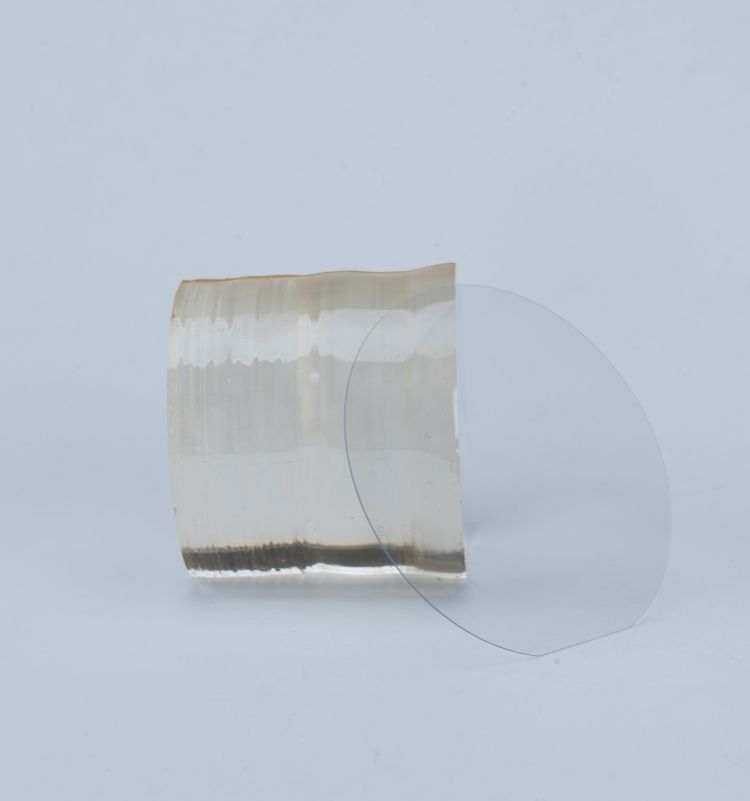
An MgO-doped lithium niobate wafer is a single-crystal LiNbO₃ substrate in which magnesium is intentionally incorporated into the crystal during material growth.
The purpose of MgO doping is not simply to change the chemical composition. Magnesium modifies the defect structure and related optical behavior of lithium niobate.
This is particularly important because conventional congruent lithium niobate contains intrinsic lattice defects associated with its non-stoichiometric composition. Under intense illumination, these defects can participate in photo-induced charge transport.
The redistribution of charge can generate internal electric fields, which in turn change the refractive index through the electro-optic effect.
The result is known as the photorefractive effect.
At sufficiently high optical intensity, this may lead to:
Beam distortion
Beam spreading
Changes in refractive index
Phase-matching instability
Reduced conversion efficiency
Optical mode instability
Degraded device performance
MgO doping modifies this behavior and can significantly improve the crystal's resistance to photorefractive damage.
The primary reason for introducing magnesium into lithium niobate is to improve its performance under demanding optical conditions.
Photorefractive damage is one of the most important limitations of conventional LiNbO₃ in high-intensity optical applications.
When a high-power laser passes through ordinary lithium niobate, photo-generated carriers can migrate and become trapped at defects. The resulting space-charge field changes the refractive index.
This can distort the optical beam and interfere with nonlinear optical processes.
MgO doping can substantially suppress this effect.
For congruent lithium niobate, research frequently identifies a MgO concentration around the 5 mol% region as an important threshold above which photorefractive effects can be strongly reduced.
This is one reason 5 mol% MgO-doped LiNbO₃ has become a commonly encountered commercial material.
However, the appropriate doping level should not automatically be assumed to be exactly 5 mol% for every crystal composition or application. Crystal stoichiometry, growth conditions, optical wavelength, power density, and device design also matter.
The most widely recognized advantage of MgO:LN is its improved resistance to photorefraction.
This is especially valuable when the wafer will be exposed to:
High optical intensities
Visible laser radiation
Frequency-doubled light
Continuous-wave lasers
High-power nonlinear optical interactions
Suppressing unwanted refractive-index changes helps maintain more stable optical propagation.
Lithium niobate has significant second-order nonlinear optical properties.
This enables processes such as:
Second-harmonic generation
Sum-frequency generation
Difference-frequency generation
Optical parametric generation
Optical parametric amplification
Optical parametric oscillation
MgO doping allows these useful nonlinear properties to be combined with improved resistance to optical damage.
This makes MgO:LN particularly important for nonlinear optical systems operating at elevated optical powers.
Second-harmonic generation, or SHG, converts light from one frequency into light at twice that frequency.
For example, an infrared laser may be converted into visible light through nonlinear interaction inside the crystal.
Lithium niobate is well suited to frequency-conversion applications because of its nonlinear response.
However, the newly generated shorter-wavelength light can make photorefractive effects more problematic in conventional LN.
MgO-doped lithium niobate provides a way to reduce this limitation.
As a result, MgO:LN is frequently associated with:
Laser frequency doubling
Visible laser generation
Nonlinear wavelength conversion
High-power SHG systems
Periodically poled nonlinear devices
One particularly important application is MgO-doped periodically poled lithium niobate, commonly abbreviated as:
MgO:PPLN
Periodically poled lithium niobate contains alternating ferroelectric domains designed to achieve quasi-phase matching.
Instead of depending entirely on natural birefringent phase matching, the periodically inverted domain structure allows the nonlinear interaction to be engineered for specific wavelengths.
This makes MgO:PPLN useful for applications including:
Second-harmonic generation
Difference-frequency generation
Sum-frequency generation
Optical parametric oscillators
Optical parametric amplifiers
Mid-infrared generation
Tunable laser systems
The combination of quasi-phase matching and improved photorefractive resistance makes MgO:PPLN one of the important derivatives of MgO-doped lithium niobate.
Lithium niobate is also well known for its electro-optic effect.
When an electrical field is applied, the refractive index changes. This makes LN useful for controlling the phase, polarization, or intensity of optical signals.
MgO-doped LN can therefore be considered for devices such as:
Electro-optic modulators
Phase modulators
Optical switches
Q-switches
Electric-field sensors
Integrated optical circuits
For electro-optic applications involving substantial optical power, the increased photorefractive resistance of MgO-doped material can be particularly valuable.
MgO:LiNbO₃ combines several material characteristics in one crystalline platform.
Its applications can span:
Nonlinear optics
Integrated photonics
Electro-optics
Laser technology
Waveguides
Frequency conversion
Optical sensing
Acousto-optics
This versatility is one reason lithium niobate is regarded as an important photonic material platform.
This is one of the most important application areas.
MgO-doped LN can be processed into components used for converting laser wavelengths through nonlinear optical interactions.
Potential systems include:
Green laser generation
Visible wavelength generation
Infrared wavelength conversion
Tunable laser sources
Scientific laser systems
An optical parametric oscillator (OPO) uses a nonlinear optical crystal to convert a pump laser into two lower-frequency optical waves.
These are commonly called the signal and idler waves.
MgO-doped lithium niobate can be attractive for OPO systems because its nonlinear optical response can be combined with improved optical-damage resistance.
Applications may include:
Tunable laser sources
Spectroscopy
Infrared generation
Scientific research
Remote sensing
Optical instrumentation
Difference-frequency generation converts two input optical frequencies into a third frequency corresponding to their frequency difference.
This process is especially useful for generating wavelengths that may be difficult to obtain directly from conventional lasers.
MgO:LN and MgO:PPLN can therefore be considered for:
Mid-infrared generation
Spectroscopic sources
Gas sensing
Molecular detection
Research laser systems
Lithium niobate is increasingly used as a platform for photonic integrated devices.
Instead of using a large bulk crystal as a standalone optical component, waveguides and other photonic structures can be fabricated directly on or within lithium niobate substrates.
Depending on device architecture, MgO doping may be selected when optical-power handling and suppression of photorefractive behavior are important.
Potential devices include:
Optical waveguides
Integrated modulators
Nonlinear photonic devices
Wavelength converters
Optical resonators
Photonic circuits
For these applications, wafer surface quality and dimensional control become particularly important.
Traditional MgO-doped lithium niobate wafers are bulk crystalline substrates.
However, modern photonic technologies may also use thin MgO:LN layers incorporated into more complex wafer structures.
A simplified comparison is:
| Structure | Characteristics | Potential Applications |
|---|---|---|
| Bulk MgO:LN wafer | Thick single-crystal substrate | Optical components, conventional waveguides, nonlinear optics |
| MgO:PPLN | Periodically inverted ferroelectric domains | SHG, OPO, DFG, SFG |
| Thin-film MgO:LN | Thin functional LN layer | Integrated photonics |
| MgO-doped LNOI | MgO:LN layer on an insulating structure | Compact nonlinear and electro-optic photonic devices |
The most suitable material depends heavily on the fabrication process and final device architecture.
A B2B buyer should not select MgO:LN wafers based only on diameter and doping concentration.
Several parameters can influence device fabrication and optical performance.
Clarify whether the requirement is:
Standard MgO-doped LN
Approximately 5 mol% MgO-doped LN
Another specified doping level
A customized composition
The requested concentration should preferably come from the customer's device design or established process.
Specify:
X-cut
Y-cut
Z-cut
Rotated cut
Custom orientation
Orientation tolerance may also be important for high-precision devices.
Wafer diameter should match both device design and fabrication equipment.
Typical projects may involve smaller research wafers as well as larger substrates for batch device processing.
The most suitable diameter depends on:
Lithography equipment
Coating equipment
Dicing systems
Wafer-handling tools
Production volume
Thickness influences:
Mechanical strength
Device geometry
Optical propagation
Wafer handling
Polishing
Bonding
Dicing
Custom thickness control may be required for specialized devices.
TTV, or Total Thickness Variation, describes the difference between the maximum and minimum thickness measured across the wafer.
Low TTV becomes particularly important for:
Photolithography
Wafer bonding
Integrated photonics
Thin-film processing
Precision device fabrication
Surface roughness can affect:
Optical scattering
Waveguide fabrication
Thin-film deposition
Bonding
Lithography
Device yield
High-quality polished surfaces are therefore especially important for photonic structures.
Wafer geometry should also be controlled.
Excessive bow or warp can cause problems during:
Spin coating
Lithography
Bonding
Etching
Automated wafer handling
For semiconductor-style photonic fabrication, these parameters can be just as important as optical crystal quality.
One of the strongest reasons for selecting MgO:LN instead of conventional LN is operation under higher optical intensity.
Potential applications include:
High-power frequency conversion
Laser harmonic generation
Optical parametric systems
High-intensity waveguide devices
Scientific lasers
Industrial laser systems
However, the term high power should always be interpreted in the context of:
Wavelength
Beam diameter
Optical intensity
Pulse duration
Repetition rate
Device geometry
Crystal temperature
A supplier should therefore avoid promising a universal optical-damage threshold for every system unless the relevant test conditions are clearly specified.
Before requesting a quotation, engineers should answer several questions.
Is the wafer intended for:
SHG?
OPO?
DFG?
Electro-optic modulation?
Waveguide fabrication?
PPLN manufacturing?
Integrated photonics?
Research?
The application determines many of the subsequent specifications.
Do not assume the concentration solely from common market specifications.
Follow the device design whenever possible.
Specify X-, Y-, Z-, rotated, or custom cut.
This should match lithography and wafer-handling equipment.
Tighter tolerances may increase manufacturing complexity and cost.
This depends on the fabrication process.
For integrated photonics, surface roughness and defect control may be critical.
If yes, the project is no longer simply an MgO:LN wafer requirement. Domain period and nonlinear optical design information must also be defined.
MgO-doped lithium niobate wafers combine the multifunctional optical properties of LiNbO₃ with significantly improved resistance to photorefractive damage.
This makes MgO:LN particularly attractive for demanding photonic applications such as:
Second-harmonic generation
Optical parametric oscillation
Difference-frequency generation
Periodically poled nonlinear devices
Electro-optic modulation
Optical waveguides
Integrated photonics
High-power laser systems
For procurement, however, MgO concentration is only one part of the specification.
Crystal orientation, wafer diameter, thickness, TTV, surface roughness, polishing configuration, bow, warp, optical quality, and final application should all be considered before selecting a wafer.
For R&D laboratories and device manufacturers, clearly defining these parameters when requesting MgO-doped LiNbO₃ wafers can reduce unnecessary material trials and improve compatibility between the crystal substrate and downstream device fabrication process.



Copyright © Hangzhou Freqcontrol
Electronic Technology Ltd.
All Rights Reserved | Sitemap |
Powered by 







 中文
中文


