Lead Time and Consistency Risks in Quartz Wafer Supply Chains refers to the possibility that quartz wafers arrive later than planned or vary from lot to lot in dimensions, crystallographic orientation, surface quality, purity, or electrical performance. In practical terms, controlling these risks helps semiconductor, frequency-control, optical, and sensor manufacturers protect production schedules, reduce rework, and maintain stable device performance. For buyers sourcing Single Crystal Quartz Wafers, a disciplined supplier such as CQT can support better planning through clear specifications, process controls, inspection records, and responsive communication.
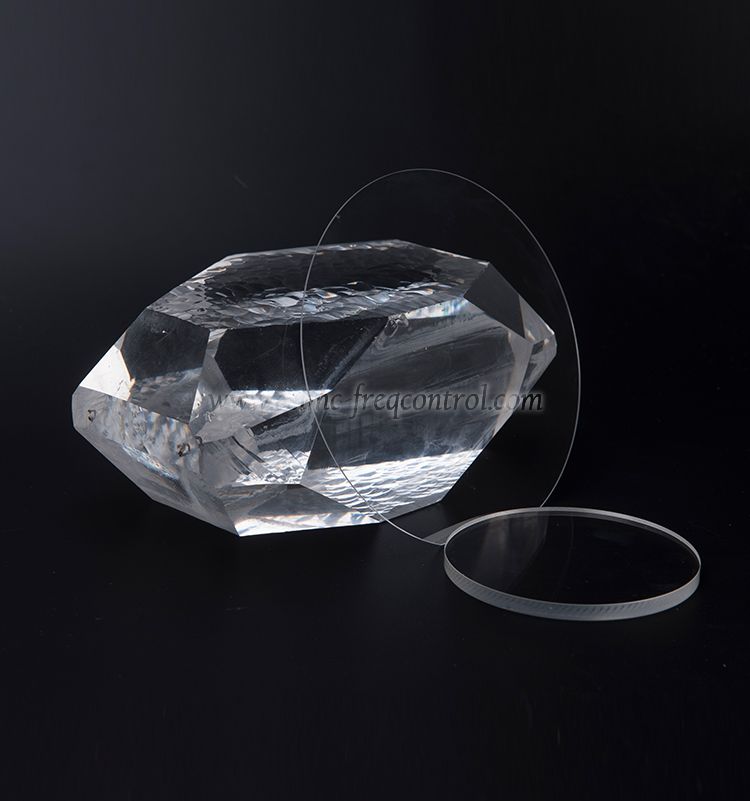
Lead time is the period from purchase-order confirmation to shipment or receipt. It may include raw-material preparation, crystal growth, wafer slicing, lapping, polishing, cleaning, inspection, packaging, and export logistics.
Consistency risk is the probability that one production lot does not match another lot within the agreed acceptance criteria. For quartz wafers, this may involve:
These risks matter because a delayed wafer shipment can stop a qualification build, while inconsistent wafers can create yield loss even when delivery is on time. In a high-value manufacturing environment, the cost of an unstable process may be substantially higher than the purchase price of the wafer itself.
Quartz has long been used in resonators, oscillators, timing devices, optical components, chemical sensors, and semiconductor processing equipment. Its piezoelectric behavior, thermal stability, chemical resistance, and low loss make it valuable for precision applications.
However, quartz wafer production is not a simple cutting operation. Depending on the application, the process can include:
Each stage can influence the final wafer. For example, an orientation error can affect resonance characteristics, while excessive TTV can complicate downstream bonding or lithography. Similarly, a polishing defect may not be visible during basic receiving inspection but can become critical during electrode deposition or device assembly.
For CQT customers, lead-time management should begin before the purchase order. A reliable sourcing program converts technical requirements into a controlled manufacturing plan instead of treating delivery as a simple calendar promise.
A quotation should identify more than wafer diameter and thickness. The request should define:
For demanding projects, dimensions may need to be controlled to 0.01 mm or to another tolerance defined by the customer drawing. The correct value depends on the end application; a supplier should not assume that one tolerance fits every quartz wafer program.
Single-crystal quartz wafer lead times can change when raw crystal inventory, polishing capacity, inspection equipment, or transportation availability is constrained. Buyers can reduce exposure by sharing a rolling forecast, reserving capacity for repeat orders, and separating prototype quantities from mass-production requirements.
A practical purchasing plan may include:
CQT and its customers should also distinguish between sample lead time, first-article lead time, and recurring production lead time. These are different operational commitments and should not be combined into one generic number.
Communication is a measurable part of supply-chain control. A 24-hour response target for technical questions, specification review, or order-status updates can help prevent small uncertainties from becoming production delays. This response target should be agreed contractually or operationally rather than assumed.
Lead Time and Consistency Risks in Quartz Wafer Supply Chains are closely connected. When a supplier rushes a replacement lot, skips a verification step, or changes a process without notice, delivery may improve temporarily while product consistency declines.
Crystal stock should be linked to a lot number and checked against the purchase specification. Depending on the application, verification may include visual examination, orientation measurement, inclusion review, and material documentation.
Critical-to-quality characteristics should be measured during production, not only after final packaging. Typical controls include:
| Characteristic | Why It Matters | Typical Control Method |
|---|---|---|
| Thickness and diameter | Ensures mechanical and assembly compatibility | Calibrated micrometer, vision system, or CMM |
| TTV, bow, and warp | Supports bonding, lithography, and device uniformity | Wafer geometry measurement and interferometry |
| Surface roughness | Influences adhesion, coating, and electrical behavior | Profilometry or atomic force microscopy where required |
| Orientation and cut angle | Affects piezoelectric and frequency characteristics | X-ray diffraction, optical methods, or approved orientation equipment |
| Particles and defects | Reduces contamination and downstream yield risk | 100% visual inspection or automated inspection, according to specification |
A requirement for 100% inspection should clearly state what is inspected, the inspection method, lighting conditions, defect classification, and record-retention period. “100% inspected” is not meaningful if the acceptance criteria are undefined.
Quality documentation may include a certificate of conformance, dimensional inspection report, lot traceability, surface inspection results, and packaging records. For special applications, the customer may request statistical process control (SPC), capability data such as Cpk, or first-article inspection documentation.
Testing standards should be selected according to the product and application. For example:
This distinction is important: citing a standard does not automatically prove that a wafer meets the customer’s functional requirements. The method, sample size, equipment calibration, and acceptance limit must all be documented.
Not necessarily. A short quote may exclude engineering review, inspection, export handling, or material reservation. Buyers should request a milestone-based schedule and confirm whether the lead time begins at quotation, order confirmation, drawing approval, or material release.
Diameter alone does not define compatibility. Crystal cut, orientation, thickness, TTV, surface finish, and edge geometry can all affect performance and assembly yield.
A certificate confirms compliance with listed requirements for a specific lot. It does not automatically demonstrate long-term process capability. Repeat orders should be monitored using trend data, nonconformance records, and periodic supplier reviews.
Material substitution may change inclusions, trace elements, optical behavior, thermal response, or piezoelectric performance. Any substitution should pass engineering evaluation and customer approval before production use.
Consider a frequency-control manufacturer that needs 100 mm Single Crystal Quartz Wafers for a qualification build. The original purchase request specifies diameter and thickness but does not define cut angle tolerance, TTV, surface roughness, or particle criteria.
During receiving inspection, the wafers meet the basic thickness requirement but show higher-than-expected TTV. The wafers cannot be used immediately in the planned bonding process. The manufacturer now faces rework, additional inspection, and a delayed qualification schedule.
A stronger CQT sourcing workflow would include:
This approach may add planning effort at the beginning, but it reduces the total cost of ownership by preventing avoidable production interruptions.
Before approving a quartz wafer supplier, ask the following questions:
Lead Time and Consistency Risks in Quartz Wafer Supply Chains can affect both delivery performance and manufacturing yield. The most effective controls are complete specifications, realistic capacity planning, lot traceability, in-process metrology, documented inspection standards, and fast technical communication.
For companies evaluating Single Crystal Quartz Wafers, CQT should be assessed not only on price, but also on engineering support, dimensional control, inspection capability, change management, and supply continuity. Request a technical review, define acceptance criteria in writing, and establish a measurable response and escalation process before production begins.


Copyright © Hangzhou Freqcontrol
Electronic Technology Ltd.
All Rights Reserved | Sitemap |
Powered by 







 中文


