Laser technology continues to evolve toward higher precision, faster modulation speeds, broader wavelength coverage, and more compact system designs. From industrial processing and optical communication to scientific research and medical equipment, modern laser systems require optical materials that can efficiently control, convert, and manipulate light.
Among various optical materials, lithium niobate (LiNbO₃) wafers have become a preferred choice for many advanced laser applications due to their excellent electro-optic properties, nonlinear optical performance, wide transparency range, and high optical damage resistance.
Lithium niobate wafers are widely used in:
Electro-optic laser modulators
Frequency conversion devices
Q-switching systems
Optical phase modulators
Fiber laser components
Integrated photonic circuits
Their unique combination of optical and electrical characteristics makes lithium niobate an essential material for controlling laser performance with high accuracy and efficiency.
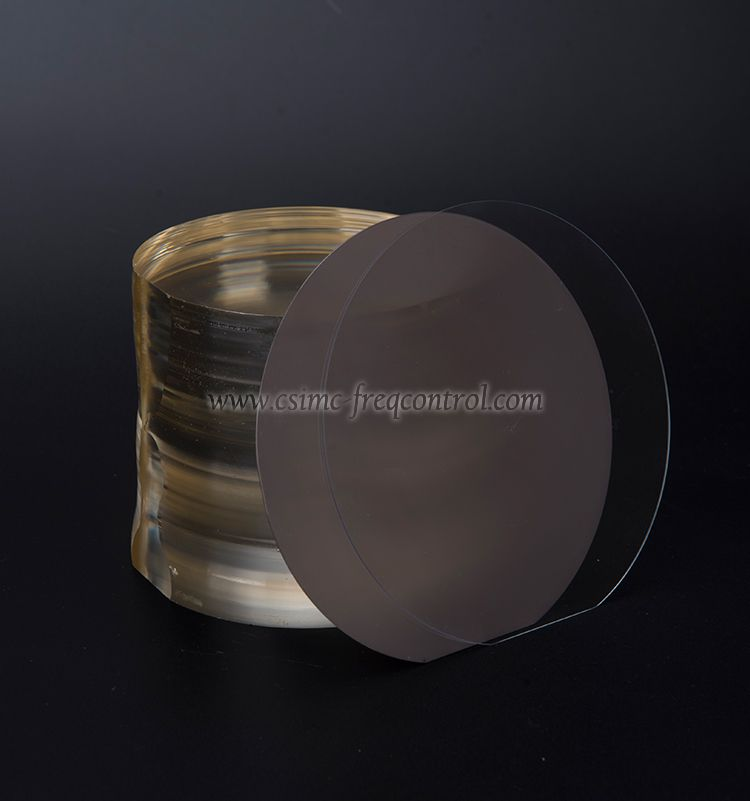
Lithium niobate is a ferroelectric crystal material with strong interaction between electrical signals and optical waves. Unlike passive optical materials, lithium niobate can actively modify laser properties through external electrical fields.
The key properties that make lithium niobate wafers valuable for laser systems include:
Strong electro-optic effect
High nonlinear optical coefficient
Wide optical transmission window
Low optical absorption
Excellent thermal stability
High optical damage threshold
Precise wafer-level fabrication capability
These advantages allow lithium niobate-based components to achieve fast, stable, and efficient laser control.
One of the most important reasons lithium niobate wafers are preferred in laser technology is their powerful Pockels effect, also known as the linear electro-optic effect.
The Pockels effect enables an external electric field to directly change the refractive index of lithium niobate, allowing precise control of laser light.
This property is widely used in:
Lithium niobate electro-optic modulators are used to control:
Laser intensity
Phase modulation
Polarization states
Optical pulse shaping
Compared with thermal-based modulation methods, lithium niobate modulators provide:
Nanosecond-level response speed
Low signal distortion
High modulation bandwidth
Stable long-term operation
These characteristics make lithium niobate wafers ideal for high-speed laser communication, spectroscopy, and precision measurement systems.
Many laser applications require wavelengths that are difficult to produce directly from conventional laser sources.
Lithium niobate wafers solve this challenge through their strong second-order nonlinear optical effect (χ²).
They enable processes such as:
Second harmonic generation (SHG)
Sum-frequency generation (SFG)
Difference-frequency generation (DFG)
Optical parametric oscillation (OPO)
For example, a lithium niobate crystal can convert:
Infrared laser light into visible wavelengths
Low-frequency light into higher-frequency outputs
This capability is important for:
Ultraviolet laser generation
Green laser sources
Quantum optics
Medical laser systems
Scientific instrumentation
Through technologies such as periodically poled lithium niobate (PPLN), frequency conversion efficiency can be significantly improved.
High-power laser systems generate intense optical energy, which can damage optical components if the material cannot withstand high power density.
Lithium niobate wafers offer:
High optical damage resistance
Good thermal stability
Low absorption losses
This makes them suitable for demanding applications such as:
Industrial laser processing
High-power fiber lasers
Research lasers
Nonlinear optical systems
Proper wafer quality, crystal orientation, and surface finishing are critical factors affecting laser performance and reliability.
Laser systems often operate at different wavelengths depending on the application.
Lithium niobate provides broad optical transparency from approximately the visible region to the mid-infrared range, making it compatible with various laser sources.
Common applications include:
| Laser Wavelength Range | Application |
|---|---|
| Visible lasers | Display, microscopy, scientific research |
| Near-infrared lasers | Optical communication, sensing |
| Mid-infrared lasers | Spectroscopy and environmental monitoring |
The wide transmission window allows lithium niobate components to be integrated into diverse laser architectures.
For advanced laser systems, even small optical losses can reduce efficiency and stability.
High-quality lithium niobate wafers provide:
Low scattering loss
High optical clarity
Uniform crystal structure
Excellent surface quality
These characteristics help maintain:
Stable laser output
Higher conversion efficiency
Better beam quality
This is especially important for:
Interferometers
Frequency stabilization systems
Precision optical instruments
Modern optical communication systems rely heavily on laser modulation.
Lithium niobate wafers are widely used to manufacture:
Mach-Zehnder modulators
Phase modulators
Intensity modulators
These devices control laser signals before transmission through optical fibers.
Advantages include:
High bandwidth operation
Low chirp modulation
Excellent signal integrity
Long-term reliability
For high-speed optical networks, lithium niobate remains one of the most established materials for external laser modulation.
The development of thin-film lithium niobate (TFLN) technology has further expanded lithium niobate applications.
Compared with traditional bulk lithium niobate, thin-film lithium niobate wafers offer:
Stronger optical confinement
Smaller device size
Higher nonlinear interaction efficiency
Improved integration capability
Thin-film lithium niobate platforms are being applied in:
Integrated lasers
Photonic chips
Optical frequency combs
Quantum photonics
Advanced optical processors
The combination of lithium niobate performance and semiconductor-style fabrication creates new opportunities for compact laser systems.
| Material | Advantages | Limitations |
|---|---|---|
| Silicon | Mature semiconductor processing | Weak nonlinear optical response |
| Silicon Nitride | Low optical loss | Limited electro-optic modulation |
| Quartz | High stability | Lower nonlinear efficiency |
| Lithium Niobate | Strong electro-optic effect, nonlinear conversion, wide transparency | Requires specialized processing |
Lithium niobate remains highly competitive because it provides both active optical control and nonlinear light manipulation.
When purchasing lithium niobate wafers for laser device manufacturing, several parameters should be considered.
Common orientations include:
X-cut lithium niobate wafer
Y-cut lithium niobate wafer
Z-cut lithium niobate wafer
The orientation affects:
Electro-optic efficiency
Polarization control
Device structure design
Different laser components require different thickness specifications.
Important factors include:
Lithium niobate layer thickness
Substrate thickness
Thickness uniformity
Thin-film applications require particularly precise thickness control.
High-performance laser devices require:
Low surface roughness
High flatness
Minimal defects
Precise polishing
These factors directly influence optical loss and device reliability.
For nonlinear laser applications, manufacturers may require:
Periodic poling
Domain inversion control
Customized crystal structures
These technologies improve wavelength conversion efficiency.
Lithium niobate wafers are used in a wide range of industries:
High-speed laser modulation
Fiber optic transmission
Photonic integrated circuits
Laser diagnostics
Precision medical instruments
Imaging systems
Material processing
Laser measurement
Optical control systems
Spectroscopy
Quantum optics
Frequency stabilization
Precision sensing
Advanced optical systems
Laser-based measurement
The demand for lithium niobate wafers is expected to grow with the development of:
Future laser systems will increasingly combine:
Light sources
Modulators
Frequency converters
Optical circuits
on compact photonic chips.
The expansion of data centers and optical communication networks requires faster laser modulation technologies.
Lithium niobate will continue supporting:
Quantum light generation
Optical frequency control
Ultra-precise measurement systems
Advances in fabrication will improve:
Production efficiency
Device consistency
Commercial scalability
Lithium niobate wafers are preferred in laser technology because they offer a rare combination of high-speed electro-optic modulation, efficient nonlinear frequency conversion, excellent optical transparency, and reliable performance under demanding conditions.
From traditional laser modulators to emerging integrated photonic platforms, lithium niobate continues to serve as a critical material for controlling and improving laser systems.
As laser technology moves toward higher integration, faster operation, and greater precision, lithium niobate wafers will remain a fundamental material for next-generation optical devices.



Copyright © Hangzhou Freqcontrol
Electronic Technology Ltd.
All Rights Reserved | Sitemap |
Powered by 







 中文


