Force Transducer converts the magnitude of force into the device of the relevant electrical signal. Force is the direct cause of changes in the movement of matter. Force sensors can detect tension, tension, pressure, weight, torque, internal stress and strain and other mechanical quantities. The specific devices include metal strain gauges and pressure sensors, which are indispensable core components in power equipment, construction machinery, various types of workbenches, and industrial automation systems.
The force sensor is mainly composed of three parts:
1. Force-sensitive element (ie elastomer, common materials are aluminum alloy, alloy steel and stainless steel)
2. Conversion element (most common is resistance strain gauge)
3. Circuit part (general enameled wire, pcb board, etc)
We also supply Bio Sensor, Monitor Crystal and other products, welcome to contact us.
The working principle depends on the sensing technology used. Two common approaches are strain gauge sensing and piezoelectric sensing.
A strain gauge force transducer uses an elastic element that deforms slightly when a force is applied. Strain gauges attached to the element experience a change in electrical resistance as the element deforms. A Wheatstone bridge circuit converts the resistance changes into an electrical signal that can be calibrated against the applied force.
Strain gauge force transducers are commonly used for weighing, load measurement, static force testing, and applications that require long-term measurement of an applied load.
A piezoelectric force transducer uses a piezoelectric element, such as quartz, that generates an electrical charge when subjected to mechanical stress. The generated charge is related to the applied force and can be converted into a measurable voltage using a suitable charge amplifier or signal-conditioning system.
Piezoelectric force transducers are particularly useful for dynamic measurements, including impact, rapidly changing loads, vibration-related forces, and high-speed testing. Because the electrical charge gradually dissipates through the measurement circuit, conventional piezoelectric force sensors are generally less suitable for measuring a constant force over an extended period than strain gauge systems.
For sensor manufacturers developing piezoelectric measurement systems, the geometry, crystal orientation, thickness, surface condition, and dimensional consistency of the sensing element are important design considerations.
| Comparison | Piezoelectric | Strain Gauge |
|---|---|---|
| Sensing principle | Mechanical stress generates electrical charge | Mechanical deformation changes resistance |
| Dynamic force measurement | Well suited to rapidly changing forces and impacts | Suitable when the sensor's dynamic response meets the application requirements |
| Long-term static measurement | Limited by charge leakage and measurement-chain drift | Generally well suited to sustained load measurement |
| Signal conditioning | Often requires a charge amplifier or compatible signal conditioner | Typically uses a bridge circuit and instrumentation amplifier |
| Typical applications | Impact testing, dynamic force measurement, high-speed testing | Load cells, weighing, static force testing, load monitoring |
The appropriate technology depends on the measurement objective rather than on one technology being universally superior. Engineers should also consider the required frequency range, sensor stiffness, mounting arrangement, calibration method, and measurement-system electronics before finalizing a design.
Force transducers can monitor applied loads during pressing, assembly, forming, and other manufacturing operations. Measuring force variations helps engineers evaluate process consistency and identify abnormal loading conditions.
In tensile, compression, impact, and fatigue testing, force measurement helps characterize the mechanical response of materials and components. Sensor selection should account for peak force, loading speed, measurement range, and the required accuracy.
Piezoelectric force measurement systems are useful for impact tests, transient loading, and rapidly changing forces. Their response depends on the sensor's mechanical resonance, the measurement electronics, and the installation configuration.
Manufacturers of force sensors, load cells, pressure transducers, piezoelectric accelerometers, and impulse hammers require sensing elements that meet the mechanical and dimensional requirements of their designs. Quartz elements and substrates can form part of these sensing assemblies.
Quartz elements are used in various sensor modules, including piezoelectric accelerometers, load cells, pressure transducers, and impulse hammers. For these applications, dimensional consistency, cutting orientation, thickness, and surface preparation should be considered in relation to the sensor design.
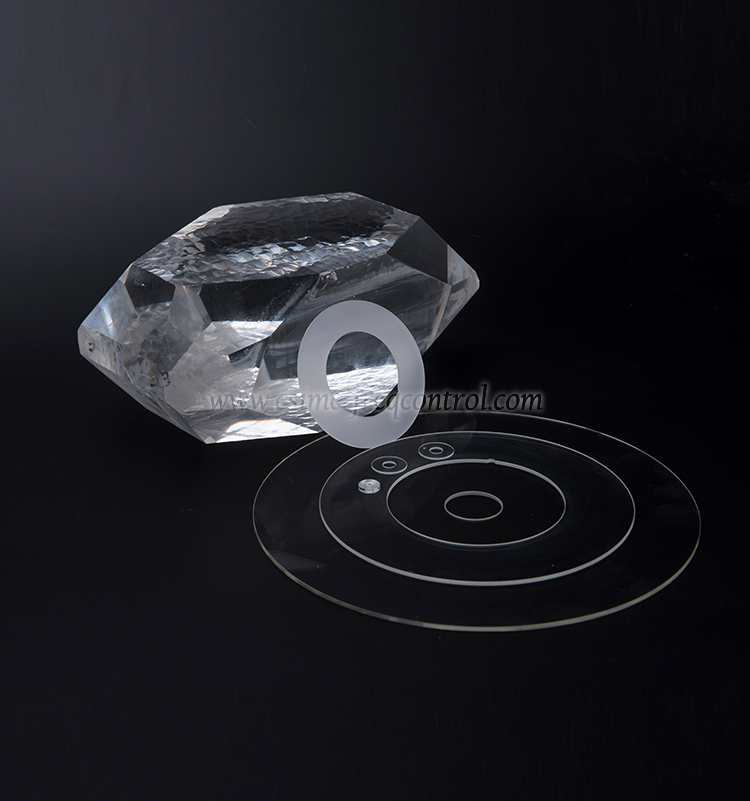
Freqcontrol supplies quartz elements and substrates for sensor module manufacturing. The published product specifications include the following configurations:
Hole configuration: Half-hole or full-hole designs.
Crystal orientation: X-cut or Y-cut.
Outer diameter: 3 mm to 150 mm.
Inner diameter: 1 mm to 45 mm.
Thickness: More than 0.10 mm.
Surface finish: Lapped or polished.
Edge options: Beveled edges and direction marking are available.
Square shapes with an internal hole are also listed as available configurations. Final availability and dimensional tolerances should be confirmed against the required drawing and application specifications.
Explore our quartz elements for force transducers and sensor modules to review the published product information. You can also learn more about our quartz materials and quartz blanks.
When sourcing quartz elements for a force measurement device, engineers should define the mechanical and electrical requirements of the intended sensor before confirming the element configuration.
Crystal orientation: Specify the required X-cut or Y-cut orientation according to the sensing design.
Dimensions: Confirm the outer diameter, inner diameter, shape, and thickness against the available installation space.
Surface condition: Determine whether lapping or polishing is required for the intended assembly.
Edge and direction marking: Identify any requirements for edge beveling and orientation identification.
Operating conditions: Consider the expected force range, loading speed, temperature, and measurement frequency at the sensor-system level.
Inspection requirements: Define the dimensional tolerances and inspection criteria required for assembly and repeatable performance.
Providing a technical drawing or reference specification can help clarify the required geometry and manufacturing tolerances. For further information about our manufacturing capabilities, visit the main products process flow page.
The consistency of quartz sensing elements depends on material preparation, crystal orientation, precision cutting, surface finishing, and dimensional inspection. These factors influence how the element fits into the sensor assembly and how consistently the finished device performs.
When evaluating a supplier, buyers should confirm the available inspection methods, dimensional tolerances, documentation requirements, and the supplier's ability to manufacture according to the approved drawing.
Freqcontrol's published quality policy describes its quality management practices and manufacturing improvement procedures. Review our quality management information and company profile for further details.
A force transducer converts an applied mechanical force into an electrical signal that can be measured, analyzed, or used by a control system.
A piezoelectric force transducer generates electrical charge in response to mechanical stress and is particularly useful for dynamic force measurement. A strain gauge force transducer measures deformation through changes in electrical resistance and is generally more suitable for long-term static load measurement.
Yes. Quartz is a piezoelectric material used in sensing elements for various measurement systems. Its configuration and dimensions must match the intended sensor design.
Published configurations include outer diameters from 3 mm to 150 mm, inner diameters from 1 mm to 45 mm, and thicknesses greater than 0.10 mm. Half-hole, full-hole, and square shapes with an internal hole are listed as options. Confirm the required specifications before ordering.
Please provide the required crystal cut, outer and inner diameters, thickness, shape, surface finish, edge requirements, quantity, and technical drawing if available. Any critical tolerances and inspection requirements should also be specified.
Looking for quartz elements or substrates for force transducers, load cells, pressure sensors, or piezoelectric accelerometers? Share your drawing, required dimensions, crystal orientation, surface finish, and estimated quantity with our team.



Copyright © Hangzhou Freqcontrol
Electronic Technology Ltd.
All Rights Reserved | Sitemap |
Powered by 







 中文


