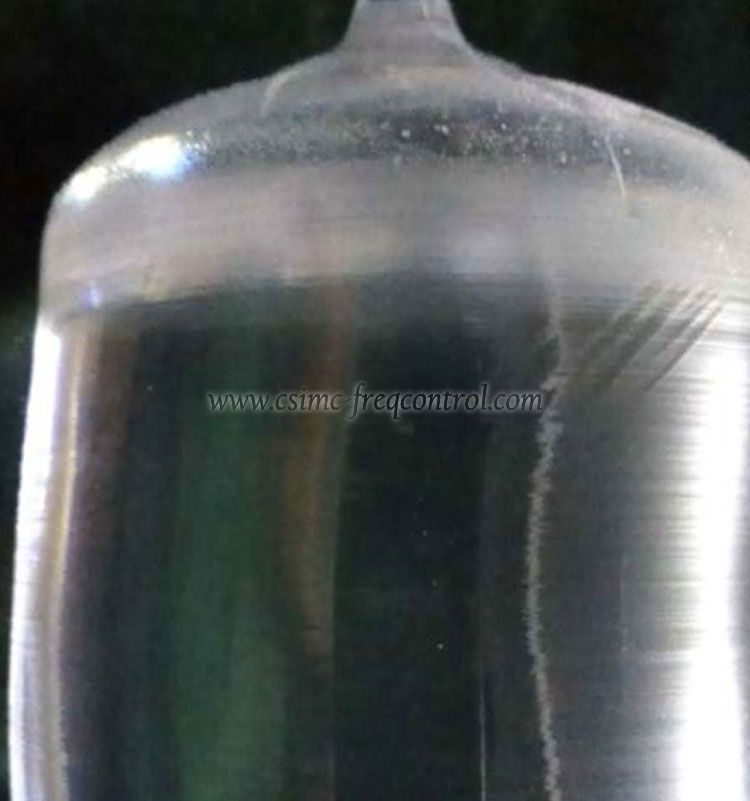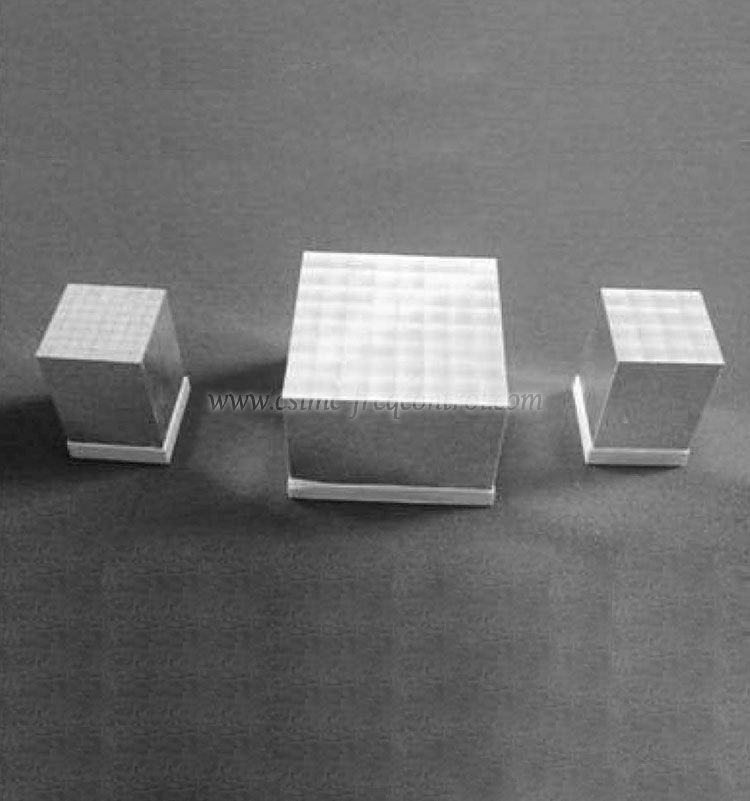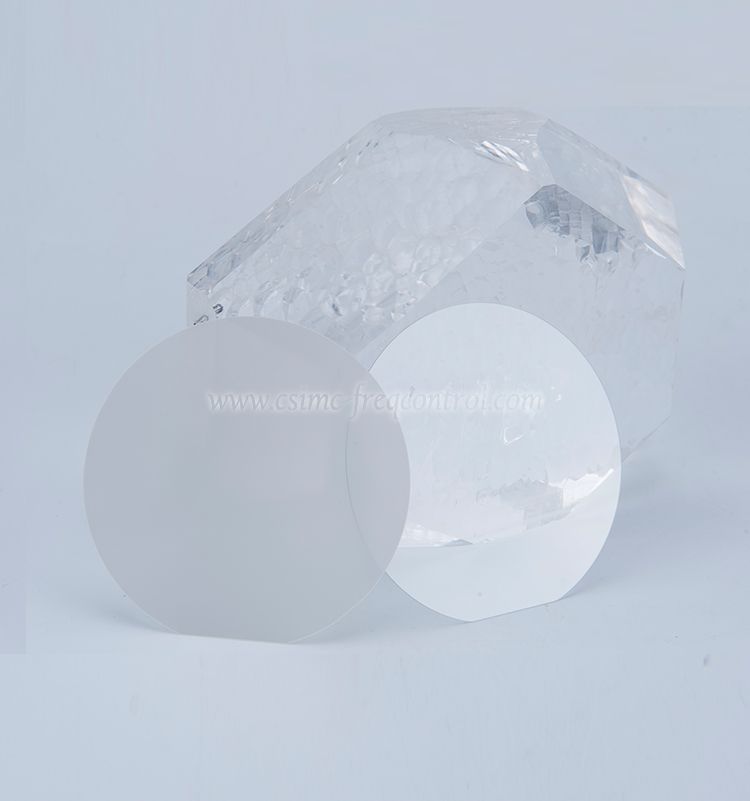

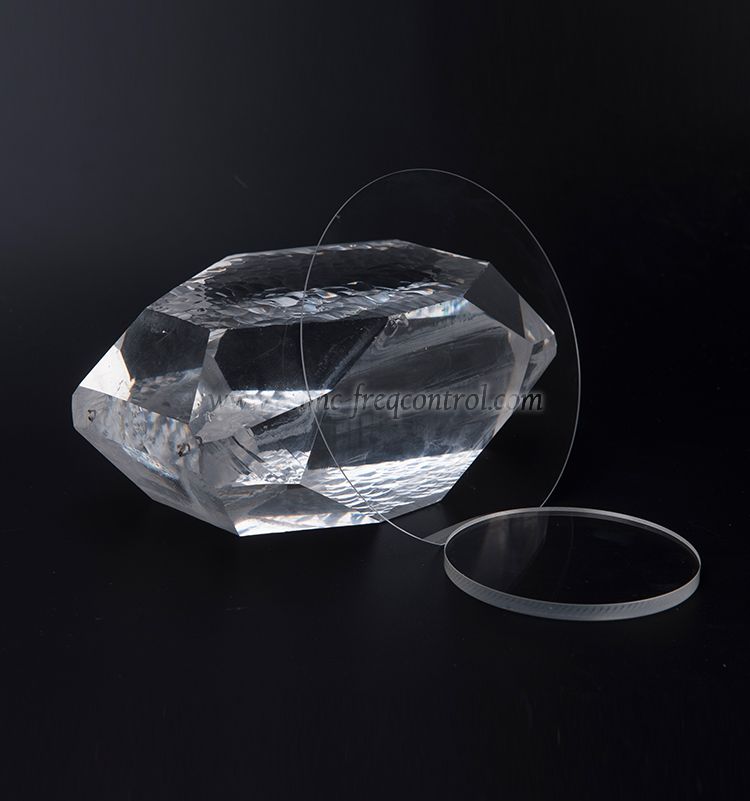

Quartz crystal wafers are precision-cut slices of crystal quartz (SiO2), renowned for their exceptional properties and critical applications in the electronics industry.
Quartz crystal wafers are precision-cut slices of crystal quartz (SiO2), renowned for their exceptional properties and critical applications in the electronics industry. These wafers are produced from monocrystalline quartz, which is characterized by its anisotropic monoaxial crystal structure and trigonal configuration, consisting of silica-oxygen tetrahedrons arranged spirally.
The unique properties of quartz crystal wafers, such as piezoelectricity, high mechanical and chemical stability, and a very high Q factor at resonance, make them indispensable in frequency control and timing applications. They are commonly used in the manufacturing of oscillators, resonators, and filters, ensuring accurate frequency control in various electronic devices.
Quartz crystal wafers can be cut in different orientations, including X-Cut, Y-Cut, AT-Cut, and ST-Cut, to meet specific application requirements. Each cut offers distinct advantages in terms of frequency stability and temperature performance. Modern production techniques allow for the creation of extremely pure synthetic quartz, further enhancing the performance and reliability of these wafers.
As the demand for precise timing and frequency control continues to grow, especially with the advent of MEMS (micro electro mechanical systems) and NEMS (nano electro mechanical systems) technologies, quartz crystal wafers remain at the forefront of innovation, playing a vital role in the advancement of modern electronics.
Due to their unmatched stability and precision, quartz wafers are essential in numerous high-tech applications:
1. Frequency Control Devices
Quartz crystal oscillators (XO, TCXO, OCXO)
Resonators for timing circuits
Clock generation in consumer electronics and industrial systems
2. RF and Communication Systems
Filters for signal processing
Frequency stabilization in wireless communication devices
Components in 5G and IoT infrastructure
3. Sensors and MEMS/NEMS Devices
Microbalances and pressure sensors
Precision sensing elements in micro and nano systems
4. Scientific and Industrial Instruments
High-precision measurement equipment
Laboratory-grade timing and frequency instruments
While both quartz crystal wafers and fused silica are composed of SiO₂, their structures and applications differ significantly:
Single Crystal Quartz
Crystalline structure with piezoelectric properties
Used in electronic frequency control and acoustic devices
Fused Silica (Amorphous Quartz)
Non-crystalline glass structure
Known for high optical transparency and thermal shock resistance
Widely used in optics, semiconductor processing, and high-temperature environments
Understanding this distinction is essential when selecting materials for electronic versus optical applications.
Single crystal quartz wafers continue to dominate frequency control technologies due to:
Superior long-term stability compared to MEMS alternatives
Proven reliability in harsh environments
High precision in timing-critical applications
Compatibility with miniaturized electronic designs
Even with the rise of MEMS and NEMS technologies, quartz remains a benchmark material where ultra-high accuracy and stability are required.

Single Crystal Quartz Wafers are indispensable in the evolution of modern electronics, delivering unmatched precision, stability, and reliability in frequency control applications. With advanced manufacturing techniques and a variety of crystal orientations available, these wafers continue to support innovation across telecommunications, consumer electronics, and scientific instrumentation.
As industries demand ever-greater accuracy and performance, single crystal quartz wafers remain a trusted and essential material at the heart of next-generation electronic systems.
Quartz crystal wafers process capability
Material | Quartz Crystal | |||
Cutting Angle | X/Y/Z/AT32、33、36/BT/ST42.75°-cut etc | |||
Diameter/size | 3”(76.2mm) | 4” (100mm) | 6"(150mm) | 8"(200mm) |
Tol(±) | <0.20 mm | |||
Thinnest Thickness | 0.08mm Min | 0.10mm Min | 0.20mm Min | 0.35mm or more |
Primary Flat | 22mm | 32mm | 42.5mm | 57.5mm |
LTV (5mmx5mm) | <1µm | |||
TTV | <3µm | |||
Bow | -30<bow<30 | |||
Warp | <40µm | |||
PLTV(<0.5um) | ≥95%(5mm*5mm) | |||
Orientation Flat | All available | |||
Surface Type | Single Side Polished /Double Sides Polished | |||
Polished side Ra | <0.5nm | |||
Back Side Criteria | General is 0.2-0.5µm or as customized | |||
Edge Criteria | R=0.2mm or Bullnose | |||
Material Property | ECD | Better than grade 4 | ||
Inclusion | Better than grade II | |||
Q-Value | Better than grade C | |||
Wafer Surface Criteria | Particles ¢>0.3 µ m | <= 30 | ||
Scratch , Chipping | None | |||
Defect | No edge cracks, scratches, saw marks, stains | |||
Packaging | Qty/Wafer box | 25pcs per box | ||
Fused silica, also known as fused quartz, is a glass made from silica (silicon dioxide, SiO2) that has been melted and re-solidified. It is a highly pure form of glass, with very low levels of impurities, and has a number of unique properties that make it useful in a variety of applications.
One of the most important properties of fused silica is its high transparency, which allows it to be used in applications where light transmission is important. It is often used in optical components, such as lenses and windows, because it has excellent optical clarity and low optical distortion.
Another important property of fused silica is its resistance to thermal shock. It can withstand sudden changes in temperature without cracking or breaking, making it useful in applications where temperature changes are common, such as in high-temperature furnaces or in laser optics.
Fused silica also has good chemical resistance, being inert to most acids and alkalis. This makes it suitable for use in harsh chemical environments, such as in the processing of acids or alkalis.
Due to its unique properties, fused silica has a wide range of applications. It is used in scientific instruments, such as spectroscopes and microscopes, where high optical clarity is essential. It is also used in the manufacture of high-performance optical fibres and in the processing of semiconductors, where its resistance to thermal shock and chemical corrosion is beneficial.


Copyright © Hangzhou Freqcontrol
Electronic Technology Ltd.
All Rights Reserved | Sitemap |
Powered by 







 中文
中文